Wallet V2026-11-04 06:55:03Wallet V breaks down OI Pulse and Momentum strategies for perpetual futures tradingWallet V has outlined how its quantitative trading system scans perpetual futures markets, ranks potential setups, and executes trades automatically based on user-defined rules. The platform currently offers two signal models: OI Pulse, which tracks unusual changes in open interest and trading activity, and Momentum, which compares price moves across markets after adjusting for each asset’s own historical volatility. The company says neither model is designed to predict future prices. Instead, both are used to compare markets side by side and identify possible trading opportunities. The article also shared backtest figures for the period from April 24, 2026 to October 30, 2026, after related costs. Momentum posted a simulated return of about +31%, OI Pulse returned about +9%, and a 50/50 combined strategy delivered about +21%. Wallet V noted that OI Pulse appears as “OI Radar” in the chart. It also said monthly performance diverged meaningfully between the two approaches, with OI Pulse outperforming Momentum in July, then falling about 18% in August while Momentum posted only a slight decline. The firm added that combined signals may help balance strengths and weaknesses, but do not guarantee higher returns or prevent losses.500
Bitrue2026-11-03 13:36:08Bitrue rolls out AI spot grid strategy for 15 crypto assetsBitrue has launched Spot Strategy, extending its AI-powered grid trading product from the futures market to spot trading. The feature covers 15 crypto assets, including XRP, BTC, ETH, and ZEC, according to Techub News, which cited BeInCrypto. The new product groups strategies by time horizon: short term for 7 to 15 days, medium term for 1 to 2 months, and long term for 3 to 6 months. Bitrue said the system scans the market every 15 minutes and updates parameters on that schedule. Each strategy is backed by a 30-day backtest and displays a set of trading details, including the trading pair, holding period, price range, minimum capital requirement, backtested grid APY, and minimum profit or loss. The interface also includes AI-based technical analysis for each strategy. The launch brings the exchange’s AI grid offering into the spot market with a structured format built around different holding periods and regularly refreshed parameters.600
Manifold2026-11-01 11:35:25Manifold founder says quant trading is not just about finding alpha, but choosing the right tableManifold founder Jae Chung used a long-form retrospective to explain how the firm built its early crypto trading business by avoiding direct competition with established quantitative giants and focusing instead on decentralized markets. He said the team initially had little formal quant experience and failed across a range of early strategies, from arbitrage and basis trades to statistical arbitrage, yield farming and deep learning. The turning point came when Manifold identified DeFi and decentralized exchanges as a market where its mix of crypto-native engineers and traditional quant researchers could build an edge. Chung described how the firm tested a rough TypeScript prototype for CEX-DEX arbitrage across venues including Binance and FTX and found that blockchain latency, passive on-chain liquidity and slower price adjustment created real opportunities even after fees. From there, the company rebuilt its stack in Go and Solidity, expanded across chains and DEXs, optimized gas usage, competed in priority gas auctions, and improved capital efficiency through an internal system called Hydra, later upgraded with Aave-based on-chain spot margin functionality. His core argument is that in trading, execution matters, but market selection matters just as much. He also said CEX-DEX arbitrage was highly profitable for a period, at times generating more than $10,000 a day on a few million dollars of capital and six-figure daily profits during volatile periods, before competition compressed returns over time.2480
AI2026-10-19 10:02:53As AI grows more powerful, the case for blockchain gets strongerForesight has published a commentary arguing that artificial intelligence and blockchain are likely to become increasingly interdependent, even though the two technologies are built on opposite instincts. The article says AI is oriented toward centralization and efficiency, while blockchain is designed around decentralization and accepts lower efficiency as the cost of reducing reliance on centralized trust. In that contrast, the author sees blockchain as more valuable, not less, as AI capabilities continue to expand. The piece also reviews several practical questions around AI and crypto. It says AI + Crypto applications have already appeared and some have generated real cash flow, but their scale remains small and no clear breakout model has emerged yet. On AI-driven trading, the author points to the niche of AI Agents running fully automated quantitative strategies, but says there is still no clear evidence that such products have outperformed traditional quant funds. The article also rejects consortium chains as "not real blockchains" and argues that ordinary users should approach crypto investing with caution, because while the capital threshold is low, the knowledge threshold is extremely high.940
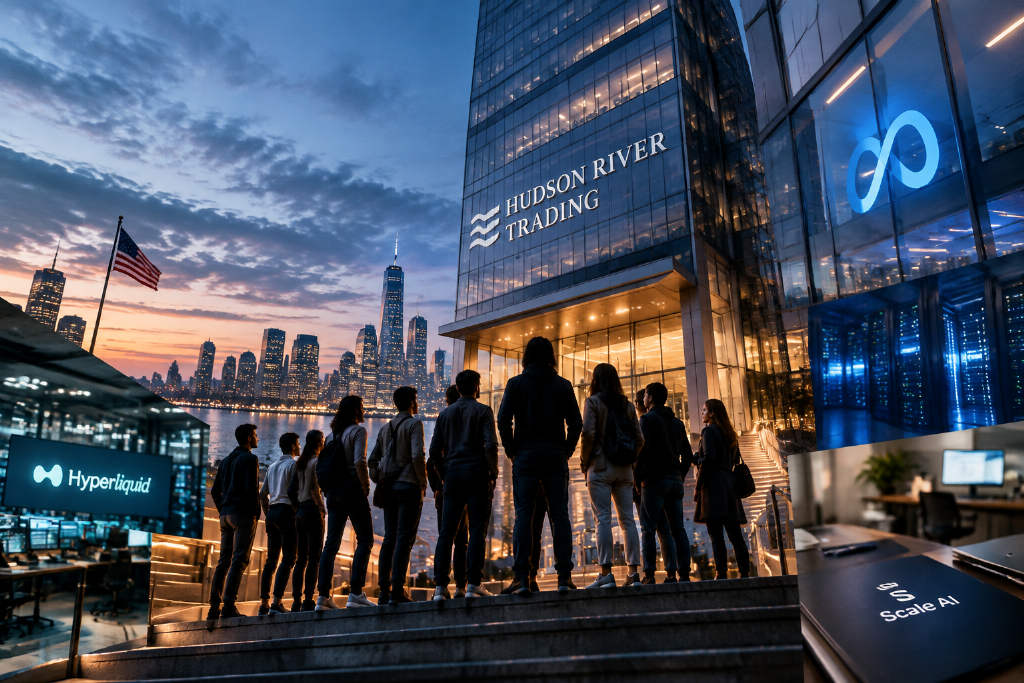
Hudson River 2026-10-19 10:11:15How HRT’s 2015 intern class grew into a $100 billion-plus founder networkA selfie posted by Meta Chief AI Officer Alexandr Wang has revived interest in one of the more unusual talent pipelines in tech: Hudson River Trading’s first intern class in the winter of 2015. The program took only 10 interns. A decade later, several of them have gone on to found or lead companies whose combined valuations now exceed $100 billion, according to the source article. The group includes Wang, the Scale AI founder who later joined Meta in a $14.3 billion deal tied to a 49% stake purchase; Jeff Yan, founder of decentralized exchange Hyperliquid; and Scott Wu, the Cognition CEO behind the AI coding agent Devin. The article traces how a small circle formed through Olympiad competitions and sharpened inside a quantitative trading firm later spread across AI infrastructure, crypto market structure, AI software engineering, customer service automation, search, and video generation. It also names other figures connected to the same orbit, including Jesse Zhang of Decagon, Johnny Ho of Perplexity, Demi Guo of Pika, and Steven Hao of Cognition. The core argument is not that they all built the same kind of company, but that they carried a similar way of thinking from math and programming contests into startups: identify an inefficient system, then rebuild it with algorithms and engineering.2230
Bitcoin2026-10-03 04:35:01Trader Killa says Bitcoin could peak at $97,000 this yearTrader Killa said Bitcoin may reach a yearly high of $97,000, while spending most of the year trading below that level, according to ChainCatcher. He identified the $80,000 to $83,000 range as the key near-term zone for BTC. If that level breaks, he said the next possible area would be $74,000 to $77,000. Killa described that range as a likely final capitulation bottom before a move toward $97,000. He also said that if strength holds, the pullback could be much shallower, with Bitcoin only dipping into the low $80,000s before the next leg higher. Killa is a BTC-focused quantitative trader with more than 200,000 followers on X. ChainCatcher noted that he called the top of the current bull market in May 2025, shorted Bitcoin at $74,688 in mid-April, and switched to a long position during the broader market sell-off on June 5.1150
Bitcoin2026-09-21 09:32:31Trader Killa says Bitcoin could target $88,000, with a short-term drop to $70,000 seen as unlikelyBlockBeats reported on Sept. 21 that trader Killa updated his Bitcoin view after a sharp move higher, saying the next upside target could reach the $88,000 area. He added that if BTC were to fall quickly back below $80,000, the price could test a low around $70,000. Still, based on his volume analysis, he said that scenario does not look likely at this stage. Killa is described as a quantitative trader focused on BTC and has more than 200,000 followers on X. According to the report, he previously called the top of the current bull market in May 2025. In mid-April, he opened a short on Bitcoin at $74,688, then switched to a long position on June 5 during a broad market decline. The latest update came in response to Bitcoin’s rapid upward move, with Killa outlining both his upside target and the downside level he would watch if momentum reverses.1200
Bitcoin2026-09-11 07:16:04Trader Killa says BTC gained more than 5% within eight days after each of the last three U.S. CPI releasesChainCatcher reported that trader Killa shared statistical data showing Bitcoin rose more than 5% within eight days after each of the last three U.S. Consumer Price Index releases. Killa said the market has already priced in negative news and argued that a bear trap is now in place, adding that he is watching to see whether a similar pattern appears this time. Killa is described as a quantitative trader focused on BTC. He previously called the top of the current bull cycle in May 2025 and has more than 200,000 followers on X. In mid-April, he opened a short on Bitcoin at $74,688, then switched to a long position on June 5 during a broad market decline.1560